
Beta
District-Defined Priority Enrollment & Lottery
From the field. A fair lottery does two things at once: it puts priority students first and gives every other family an equal chance. Each district sets its own priorities, whether that’s UPP students, McKinney-Vento, foster youth, siblings, or local needs. Attendly applies those rules, randomizes within each tier, and keeps a clear record of why every student was placed, so placements are fair, transparent, and easy to stand behind.
 Attendly
Placed: priority tier 1.
Reason on record. Letter sent to the family.
The pain
When seats are limited, the students who need them most can’t be left to chance.
State programs require districts to prioritize students such as UPP, McKinney-Vento, and foster youth, and many districts add priorities of their own. Then every other family deserves an equal chance. Doing that by hand means sorting lists, verifying eligibility, juggling capacity and scheduling conflicts, and reconstructing every decision when families, boards, or auditors ask.
How it works
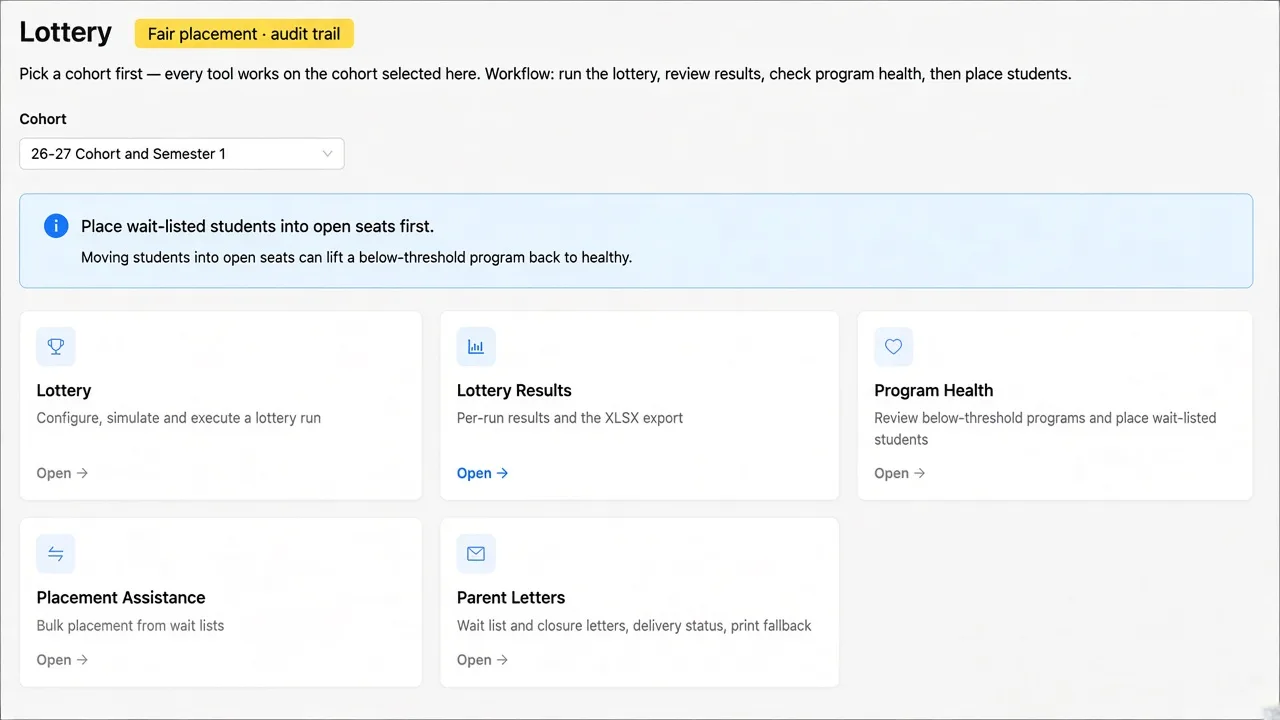
Set your priorities. Run the lottery. Place students fairly.
Lottery results
2026–27 Cohort · Semester 1
| Student | Priority | Site | Result |
|---|---|---|---|
| Student A | 1 · Foster youth | Riverview | Placed |
| Student B | 2 · Unduplicated | Riverview | Placed |
| Student C | 2 · Unduplicated | Oak Grove | Placed |
| Student D | 4 · Open | Riverview | Wait list |
Lottery results
Fair placement · audit trail- 1 · Foster youthPlaced
- 2 · UnduplicatedPlaced
- 2 · UnduplicatedPlaced
- 01
Select programs
Choose which programs are included in the lottery.
- 02
Set the rules
Define your district’s priority groups and their order, capacity, and scheduling rules.
- 03
Run
Students are placed by priority tier, with a random draw within each tier and for all remaining families.
- 04
Review
Check results before anything is final and see exactly why each student was selected or waitlisted.
- 05
Place
Confirm placements, see capacity across programs, and identify the students who still need a seat.
- 06
Communicate
Notify families using up-to-date SIS contact information and keep a record of every message sent and where it went.
Behind the buildBeta
Why a random draw isn’t enough.
-
The usual way: A randomizer picks names from a list.
How Attendly does it: District-set priorities are applied first, then a random draw gives every other family an equal chance.
-
The usual way: Priority eligibility checked by hand, one list at a time.
How Attendly does it: Priority groups are built from student data already in Attendly.
-
The usual way: Results are final the moment the draw ends.
How Attendly does it: Staff review results before anything is final.
-
The usual way: No one can explain why a student was or wasn’t picked.
How Attendly does it: Every placement and waitlist position carries its reason.
-
The usual way: Capacity and schedule conflicts sorted out afterward.
How Attendly does it: Capacity and scheduling rules are applied during the lottery.
-
The usual way: The work stops at the draw.
How Attendly does it: Placement, waitlists, and family notifications follow directly from the results.
Designed with our partners
Developed alongside Santa Ana Unified School District, the priority enrollment and lottery workflow reflects how a large district actually runs its lottery, from setting district priorities and reviewing results to tracking capacity and keeping families informed.
“I feel like this has been a long time coming since I was a program specialist trying to maneuver the workflow and figure this out. It's great to see this live, supporting my team, and delivering for our community.”
Send me this
Email yourself a link to District-Defined Priority Enrollment & Lottery, to read later or bring to your district.