
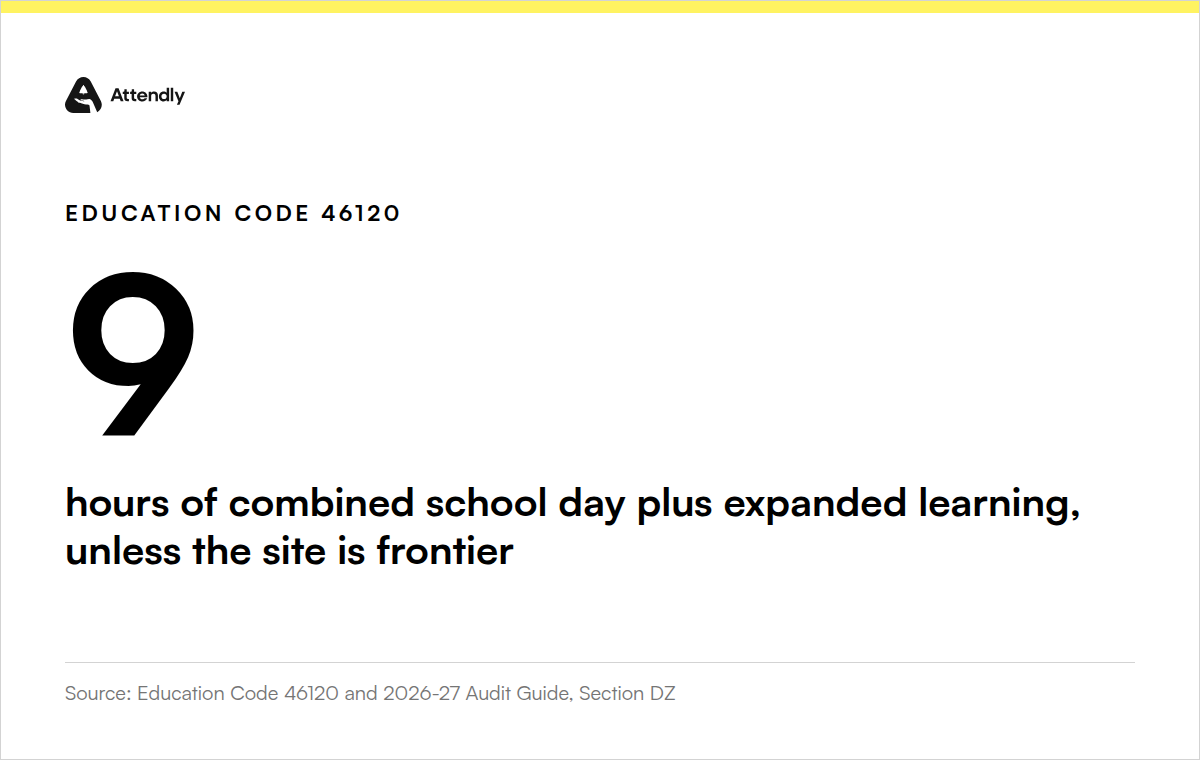
Nine hours. That is the combined instructional time, recess, meals, and expanded learning Education Code 46120 requires on a school day, unless the site is frontier. The 2026-27 Guide for Annual Audits, Section DZ is the sampling script for that test.
This page replaces our older ELO-P audit post at evidence-and-best-practices-for-elop-success. Same job. One URL. The old path 301s here.
I am writing this against the published 2026-27 guide, not against a rumor about a later supplement. The PDF cover is dated July 1, 2026. CDE’s LEA annual audits page lists that date as when EAAP adopts and issues the 2026-27 guide. CDE’s ELO-P page still says the 2024 procedures in Section DZ will be used to review 2024-25 records. That sentence is about last year’s books. For 2026-27, use the 2026-27 PDF. If your auditor is in the building this winter for 2025-26 records, the 2025-26 guide governs that engagement.
If you need the funding and CALPADS version of this year, keep using The Complete 2026 Guide to California ELOP Compliance. The SIS split still lives in Our SIS Already Tracks This. The older general audit walkthrough, A Guide to Preparing for Funding Audits in Schools, stays live.
What Section DZ is, and what it is not
Section DZ runs if the LEA received Expanded Learning Opportunities Program funds under Education Code 46120.
It is an offering and access audit, plus hours, ratios, plan elements, third-party contracts, and family fees. It is not Attendance Recovery. Recovery is Section HZ. It is not ASES pupils served. That is Section U.
DZ tells the auditor to sample schools that offer classroom-based programs in kindergarten, including TK, and grades 1 to 6. Census Day is the eligibility snapshot. For Rate 2, the unduplicated list is the school’s CALPADS snapshot report “1.18, LCFF Unduplicated Pupil Student List.” That is in procedures 4 and 5.
I do not see a LEAP file test in Section DZ. CALPADS Flash 305 still matters for certification. Do not tell fiscal that a clean LEAP file is the DZ packet.
Rate 1 or Rate 2 is the first fork
Procedure 1 is not a poster. It is a funding exhibit.
The auditor looks up the P-2 entitlement at CDE Principal Apportionment and decides whether the LEA is Rate 1 or Rate 2. Do not reverse-engineer the rate from this year’s unduplicated pupil percentage alone. Education Code 46120(d)(1)(C) sets Rate 1, from 2025-26 onward, at $2,750 per unit of prior-year P-2 TK-6 classroom-based ADA times the unduplicated pupil percentage, when that percentage is at least 55. Education Code 46120(d)(4) then keeps a Rate 1 LEA on that rate for at least three years after it becomes eligible, and drops it only after four consecutive years below the threshold. Everyone else on the exhibit is Rate 2.
There is a one-year grace. If the LEA is Rate 1 in the audit year and was Rate 2 in the prior year, Education Code 46120(c)(1)(B) and DZ procedure 1 keep that LEA on Rate 2 access tests for that first Rate 1 year only.
Which DZ procedures you actually sit
| If P-2 says | Auditor runs | Who must be offered the program |
|---|---|---|
| Rate 1, and not the first year after Rate 2 | Procedures 2, 3, and 6 through 11 | All classroom-based TK through grade 6 pupils on Census Day. DZ 1.a, 2, 3 |
| Rate 2, or first year of Rate 1 after Rate 2 | Procedures 4 through 11 | Unduplicated classroom-based TK through grade 6 pupils on Census Day, from CALPADS 1.18. DZ 1.b, 4, 5 |
Offer is recruitment. Provide access is enrollment. The statute defines both in Education Code 46120(g).
Offer is not the same as a signed form
Education Code 46120(g)(5) defines “offer access.” Recruit, advertise, publicize, or solicit through culturally and linguistically effective channels. Program information in enrollment forms. On the LEA website. Posted at each program site where the public can see it.
DZ procedures 2 and 4 tell the auditor to look at that communication. A flyer in English only, sitting in a drawer, is not the test.
Education Code 46120(g)(6) defines “provide access” as enroll. A parent or guardian signed registration form on file means the pupil is enrolled.
DZ procedures 3 and 5 sample enrolled pupils and look for that form. They also allow alternate documentation: outreach attempts to get the signature, a parent’s refusal to sign (email, signed acknowledgment, or contemporaneous staff notes), or records of regular attendance.
If the school is not operating the program on site, the same procedures ask for transportation to and from a program site. A bus schedule is enough evidence for that piece.
Parents can decline. Education Code 46120(c)(2) says pupils who opt out do not generate the offer-or-access penalty. You still have to be able to show you offered, and that you enrolled the families who asked.
Hours and days, including the three staff days
On school days, in-person before or after school expanded learning, added to instructional minutes, recess, and meals, must be no fewer than nine hours. Frontier sites, defined as fewer than 11 persons per square mile, get eight. That is Education Code 46120(b)(4)(A), (C), and (g)(2). DZ procedure 6 has the auditor sit with the attendance calendar, the bell schedule, and the ELO-P schedule, and check every sampled school day.
On at least 30 nonschool days, in-person expanded learning must be no fewer than nine hours a day, or eight if frontier. Extended school year instructional minutes may count toward that nine. Education Code 46120(b)(4)(B). DZ procedure 7.
Two exceptions sit in the same procedures:
- Up to three staff development days during regular program hours. Student attendance is not required those days. Combined across procedures 6 and 7, the auditor may exclude up to three such days. Education Code 46120(b)(11).
- Emergency closures listed in Education Code 41422 or Education Code 8482.8(d), as restated in DZ procedures 6 and 7, with a governing board resolution and documentation of the need. Then the day-and-hour penalties in 46120(c) do not apply because of that emergency. Education Code 46120(b)(12).
A spreadsheet that says “we run 9 to 6” is not a calendar. The auditor is matching dates.
Ratios, plan, vendors, fees
DZ procedure 8 checks pupil-to-staff ratios: no more than 10 to 1 if the program served TK or kindergarten pupils, and no more than 20 to 1 for other grades, per Education Code 46120(b)(5)(D). That is staff, not a certificated teacher ratio. Do not copy the Attendance Recovery 10 to 1 test from Section HZ into this folder.
DZ procedure 9 checks that the LEA ran a before school component, an after school component, or both, on one or more sites, and that each component had an educational and literacy element (tutoring or homework assistance) and an educational enrichment element. Education Code 46120(b)(5) points that test at 8482.3(c), the program plan, 8482.6, 8483.3(c)(1-9) and (12), and 8483.4. Staff and volunteers need health screening and fingerprint clearance. The 2026-27 guide restates 8483.4(a) for that clearance. Education Code 8483.3 is linked directly. 8482.3, 8482.6, and 8483.4 are cited through 46120(b)(5) and the guide, which quote those sections.
CDE still directs that the program plan be approved by the governing board in a public meeting and posted on the LEA website.
DZ procedure 10 is only if you contracted a third party. The contract has to require next-working-day notice, and a written report within seven days, of health or safety issues, including background clearances and building safety. The LEA has to require that vendor to request pupil health information, such as allergies or asthma, before enrollment. The guide cites Education Code 8483.4(b) and (d) for those two clauses.
DZ procedure 11 is only if you charge family fees. Waive them for pupils eligible for free or reduced-price meals, for a child who is a homeless youth, or in foster care. Schedule remaining fees on a sliding scale that considers family income and ability to pay. The guide cites Education Code 8482.6. So does Education Code 46120(b)(5)(B) and (b)(8).
That is what DZ samples. CDE’s Attendance Recovery FAQ 15 separately directs that a pupil cannot be charged an ELO-P fee on any day the pupil participates in both ELO-P and Attendance Recovery, citing Education Code 49011. FAQ 14 says AR itself has no fee. I am not treating that as a DZ 11 step. I am treating it as CDE’s current instruction next to the fee folder.
What a finding costs
DZ procedure 12 splits the math.
Fail procedures 2 through 5 (offer or access) and the finding uses Education Code 46120(c)(2): a withhold proportionate to the number of eligible pupils the LEA failed to offer or provide access to. Count a pupil once. Do not double-penalize the same pupil on offer and access. The guide still points auditors to CDE’s ELO-P penalty calculator. The file name still says elopauditpenaltycalc23.xlsx in the 2026-27 PDF. I am not treating that filename as a year of law. I am treating it as the calculator the current guide names.
Fail procedures 6 or 7 (days or hours) and the finding uses Education Code 46120(c)(3): for a school district, 0.0048 times the apportionment for each day the district misses the day or hour requirement. For a charter school, 0.0049. That apportionment is the amount after the offer-or-access withhold in 46120(c)(2). If you have both findings, do not multiply the unadjusted award.
Fail procedures 8 through 11 and the auditor reports noncompliance. The 2026-27 DZ text does not attach the same per-day or per-pupil formula to those four procedures. Do not invent one.
The checklist
Print this. Check boxes in the browser if that is easier. Either way, the items are the procedures, not a vendor scorecard.
Section DZ checklist for 2026-27
Statute requires. The audit guide tells the auditor how to sample. CDE's ELO-P page still talks about 2024-25 records in its audit blurb. Read the year on the PDF in your hand.
A worked fork, without invented ADA
Take three LEAs. No fake dollar recovery. The fork is the point.
Rate 2 unified. Census Day unduplicated TK-6 pupils from CALPADS 1.18 are the offer list. The auditor samples those schools, looks for family communication to unduplicated households, then samples enrolled pupils for the signed form. Hours, 30 nonschool days, and ratios still run.
Rate 1 unified, second year at Rate 1. The offer list is every classroom-based TK-6 pupil on Census Day, not only unduplicated pupils. Same hours tests. Same ratio tests. The packet gets larger because the eligible pool gets larger.
Rate 1 this year, Rate 2 last year. Run the Rate 2 access tests this year. Education Code 46120(c)(1)(B) is doing you a favor. Do not volunteer a Rate 1 offer sample and then miss it.
If Attendance Recovery shares the cafeteria after 2:30, keep the ELO-P minutes and the Recovery minutes apart. CDE directs that a pupil is in Recovery or in expanded learning in a given stretch, not both. HZ will sample the Recovery register. DZ will sample the offer. Mixing those folders is how both findings get written.
What to do this week
Open the 2026-27 guide, Section DZ. Next to it, open your P-2 ELO-P exhibit. Write “Rate 1” or “Rate 2” at the top of a folder named for this fiscal year.
Put four things in that folder before you add anything else: the offer communications, the registration forms, the school-day plus program schedules that add to nine hours, and the staff assignment that proves 10 to 1 or 20 to 1.
If you want the five questions your attendance data should already answer, that is the compliance-gap checklist.
FAQ
Is this the 2026-27 guide or last year’s? The current booklet is the 2026-27 Audit Guide, dated July 1, 2026. CDE lists that date as EAAP adoption for 2026-27. CDE’s ELO-P page still describes 2024 procedures for 2024-25 records. I am not treating that CDE sentence as the 2026-27 sampling script.
Does DZ test whether kids showed up? Not the way ASES Section U traces pupils served to written records. DZ tests that you offered the program, enrolled the families who asked, ran the hours and days, and kept ratios and plan elements. Regular attendance records are an alternate way to show access, not a pupils-served count.
Do we need CALPADS 1.18? For Rate 2, and for the first year of Rate 1 after Rate 2, yes. That is the unduplicated list DZ procedures 4 and 5 name. Rate 1 in later years uses classroom-based TK-6 on Census Day.
Can we use ELO-P money for Attendance Recovery? Education Code 46120(d)(3)(B) allows it when Recovery is operated by the LEA in conjunction with, and on the same schoolsite as, the expanded learning program, and the LEA meets the supervision rules in 46211(f). That is not a license to blur the minute banks. Recovery still has to survive Section HZ.
Where did the old URL go? /blog/afterschool-programs/compliance-reporting/evidence-and-best-practices-for-elop-success/ now 301s here. The program-management post with that same slug, A Data-Driven Look at ELO-P for Program Directors, is a different article and stays.
Sources
- 2026-27 Guide for Annual Audits of K-12 Local Education Agencies, Section DZ
- Education Code 46120
- Education Code 8483.3
- Education Code 41422
- Education Code 49011
- CDE Expanded Learning Opportunities Program
- CDE Principal Apportionment
- CDE LEA annual audits
- CDE ELO-P penalty calculator (file named elopauditpenaltycalc23.xlsx)
- CDE Attendance Recovery
- CALPADS Flash 305
Where Attendly fits
The five questions your attendance data should already answer
A short checklist for expanded learning and fiscal leaders before the next reporting window.
Get the checklist