
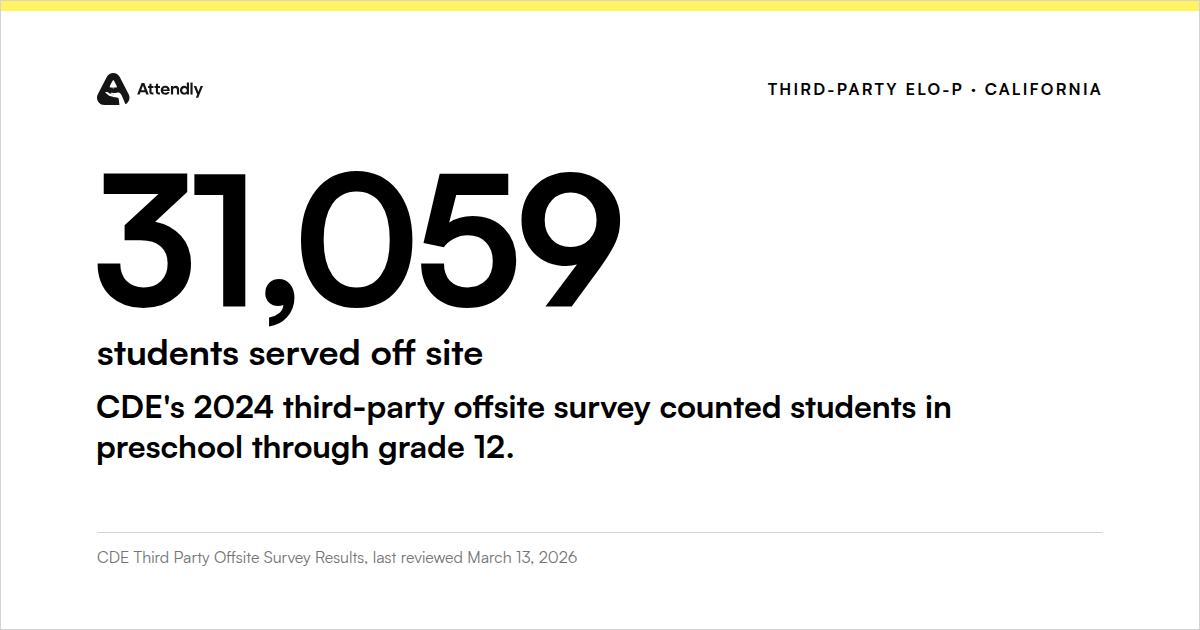
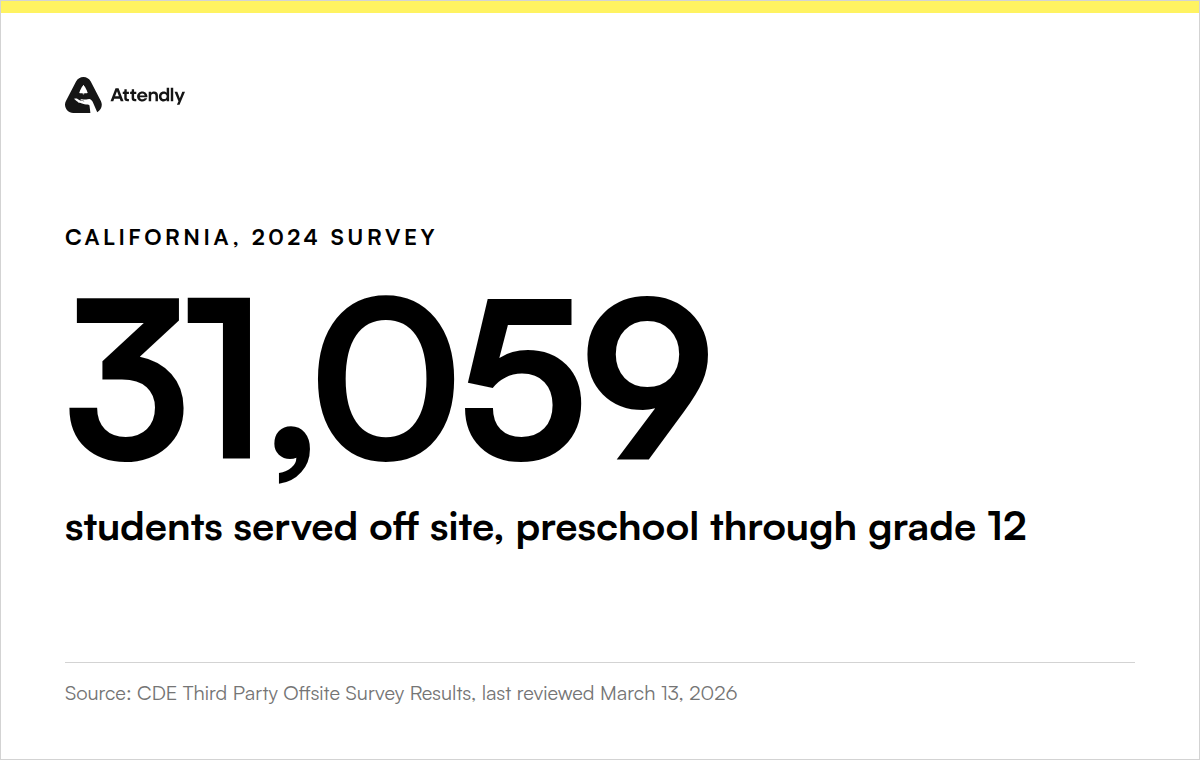
CDE’s Expanded Learning Division sent its 2024 third-party offsite survey to 1,623 local educational agencies that receive ELO-P funding. 1,490 responded. 328 of those responses reported a partnership with a third-party offsite provider. Those sites served 31,059 students in preschool through grade 12. That is CDE’s Third Party Offsite Survey Results page, last reviewed March 13, 2026. The spreadsheet on that page was posted in January 2026.
That is kids at someone else’s address. It is not a hall pass out of Education Code 46120.
The partner is still the district or charter. The community organization can run the room. It cannot carry the offer, the access test, or the audit. If you contracted the afternoon, this page is the contract language, the offsite file, and what Section DZ procedure 10 actually samples.
The hours and 30 nonschool days live in ELO-P’s 9 Hours and 30 Days. Rate 1 and Rate 2 live in the 2026-27 ELO-P rates guide. This page does not replace those. It is the vendor layer those posts only name.
The LEA still offers. The vendor still staffs.
Education Code 46120(b)(9) encourages local educational agencies to collaborate with community-based organizations and childcare providers. That sentence is permission to partner. It is not a transfer of the condition of funding.
Offer and access stay with the LEA. Rate 1 and Rate 2 still fork on who you have to offer, and which families you have to enroll when they ask. Education Code 46120(b)(2) and (b)(3). A signed registration form on file is enrollment. That is Education Code 46120(g)(6). If the form lives in the vendor’s binder and not in yours, you do not have a file. You have a hope.
Participation is still optional. Education Code 46120(b)(10). A community organization that fills every seat does not finish the access test. A community organization that turns a family away does not finish it either. The LEA enrolled, or it did not.
Three layers that stay separate
-
The LEA's duty
Offer, access, nine hours, 30 nonschool days, ratios, the posted plan, and the expenditure report. Education Code 46120.
-
The contract and the LEA requirement
Next-working-day notice and a written report within seven days of the incident, in the contract. The LEA also has to require a health-information request before enrollment. Education Code 8483.4(b) and (d).
-
The room
Staff who meet the instructional-aide floor, fingerprint and health screening, and 20 to 1 or 10 to 1. Education Code 8483.4(a). Education Code 46120(b)(5)(D).
A clean vendor scorecard is not the same as a clean LEA packet. Section DZ samples the LEA.
What 8483.4 actually puts in the contract
Education Code 46120(b)(5)(D) points ELO-P at Education Code 8483.4, then tightens the ratio for transitional kindergarten and kindergarten to no more than 10 pupils per staff member.
Education Code 8483.4(a) is the staffing floor for programs under that article. Direct supervisors of pupils have to meet the district’s minimum qualifications for an instructional aide. The program site supervisor is subject to the schoolsite principal’s approval. The default ratio is no more than 20 pupils per staff member. Staff and volunteers are subject to the health screening and fingerprint clearance requirements in current law and in district policy.
CDE’s ELO-P FAQ, last reviewed June 19, 2026, restates the instructional-aide floor and points at Education Code 45344(b): the district prescribes those qualifications, and they have to fit the work. That FAQ also says ASES and 21st CCLC aides do not pick up the extra Title I tests in Education Code 45330(c).
Then the two clauses that only fire when you contracted a third party.
Education Code 8483.4(b) requires the LEA to require the third party to notify the LEA by the next working day following a health- or safety-related issue, and to submit a written report within seven days of that occurrence. The clock on the written report starts at the incident, not at the notice. The statute names criminal background clearances, building safety, and the events in subdivision (c).
Education Code 8483.4(c) lists those events: death of a child from any cause; an injury that requires medical treatment; an unusual incident or child absence that threatens physical or emotional health or safety; suspected child abuse or neglect as defined in Penal Code 11165.6; epidemic outbreaks; poisonings; fires or explosions on the premises; exposure to toxic substances; an arrest of an employee of the third party; and any other event the LEA specifies.
Education Code 8483.4(d) requires the LEA to require the third party to request pupil health information from parents or guardians before enrollment, such as allergies or asthma. Families may provide it. They are not required to provide it in order for the pupil to receive services.
Those last two sentences are easy to invert. The vendor has to ask. The family does not have to answer. A contract that makes health forms a condition of the slot is writing a rule the statute does not write.
What the statute requires in the paper
| Clause | In the contract | Not a substitute |
|---|---|---|
| Notice | Next working day, then a written report within seven days of the incident. 8483.4(b) | A monthly incident summary. A phone call that nobody logged. |
| Events | The list in 8483.4(c), plus whatever else the LEA names. | A vendor handbook that lists "emergencies" and stops there. |
| Health ask | The LEA has to require the vendor to request allergies, asthma, and similar information before enrollment. 8483.4(d). Procedure 10b tests that LEA requirement, not a named contract sentence. | A required medical file as a ticket into the program. |
| Staff | Instructional-aide floor, principal approval of the site supervisor, fingerprint and health screening. 8483.4(a) | A brochure that says staff are "fully cleared." |
| Ratio | No more than 20 to 1, and no more than 10 to 1 if the program serves TK or kindergarten. 46120(b)(5)(D) | A Recovery 10 to 1 teacher ratio copied onto classified staff. That test is Education Code 46211. |
DZ procedure 10 only runs if you contracted a third party. Procedure 10a tests whether the contract requires next-working-day notice and a written report within seven days of the incident. Procedure 10b tests whether the LEA required the third party to request pupil health information. Education Code 8483.4(d) is that duty. The audit text does not call 10b a contract-clause test. Procedure 10 is not a pupils-served count.
Fail procedures 8 through 11 and the 2026-27 DZ text tells the auditor to report noncompliance. It does not attach the per-day withhold in Education Code 46120(c)(3) to a missing vendor clause. Do not invent a dollar. The finding is still a finding. The ELO-P audit checklist walks the rest of DZ.
Offsite is allowed. Transportation is not optional.
CDE’s ELO-P FAQ directs that ELO-P funds can pay for program access at offsite locations, and that transportation requirements have to be met. The FAQ cites “EC 41620(g)(6)”. That section is not the ELO-P statute. The transportation sentence is Education Code 46120(g)(6). I am treating the FAQ’s 41620 cite as a typo on CDE’s page, last reviewed June 19, 2026, and citing the code that actually contains the sentence.
Education Code 46120(g)(6) says that for an LEA receiving an ELO-P apportionment, transportation shall be provided for any pupil who attends a school that is not operating an expanded learning opportunity program, so that pupil can attend a location that is, and return to their original location or another location the LEA establishes.
CDE is blunt about the rest. Transportation should not be the barrier. Failure to provide it to an offsite ELO-P is an access finding, with a fiscal penalty equal to the entitlement of the affected pupils. Mileage reimbursement can satisfy the duty if the family voluntarily agrees to transport the pupil and the LEA documents the arrangement, at a reasonable rate consistent with local policy. If nobody in the family can drive, or the family declines reimbursement, the LEA still has to provide the ride.
The same FAQ says the ELO Program does not require submission of an offsite form in order to use funds off campus. That is not the same thing as Education Code 46120(e). Subdivision (e) tells the Superintendent, in consultation with the Department of Social Services, to establish a process and a timeline for LEAs that contract with third-party providers to operate ELO-P at a location other than a school campus, and for California state preschool providers, to submit program access information each year. CDE then compiles a list for Community Care Licensing and for the local resource and referral agency.
What that annual file has to include, at minimum: the name, address, and telephone number of each third party; the number of pupils served and their grade levels; the Social Services child daycare facility license number, if applicable; and a single point of contact at the LEA. Education Code 46120(e)(1) through (e)(4).
The 2024 survey results page is CDE collecting some of that picture. CDE added a 2025 results page on November 9, 2026 at thirdparty25results.asp. This environment could not read that HTML. Do not treat the 2024 counts as the 2025-26 year. Do not invent a portal due date. Watch the live CDE page and the instructions that come with the survey or certification you are actually filling out.
License, mixed funds, and a date that already passed
Education Code 46120(b)(13)(B) says an ELO-P may operate without obtaining a child daycare facility license or special permit under the Health and Safety Code chapters it names. That is not extra funding. It is an exemption for the ELO-P itself.
Education Code 46120(b)(13)(C) was a bridge. A third-party ELO-P that already held a daycare license or special permit as of June 1, 2023 had to maintain that license or permit capacity as a condition of contracting, until June 30, 2025. We are past that date. I am not treating (C) as a live 2026-27 duty. If your counsel still wants the license on the contract, that is local policy, not this sentence.
Education Code 46120(b)(13)(D) is the live trap. Nothing in 46120 exempts the program from daycare licensing when it is serving children who are not in ASES, 21st CCLC, or ELO-P. If multiple funding sources serve pupils in the same expanded learning program, a conflict in program requirements is resolved in favor of the funding source with the stricter requirements.
A licensed preschool that also holds ELO-P slots is not “ELO-P, therefore unlicensed.” Read who is in the room.
A worked afternoon, without invented dollars
Take a classroom-based elementary that is not frontier. The school day ends. TK and grade 2 do not have an on-campus ELO-P. The LEA contracts a community organization two miles away.
The LEA still has to offer the program. The mandatory access test is classroom-based TK through grade 6. A Rate 1 LEA must enroll any of those pupils whose family asks. A Rate 2 LEA must enroll any of those unduplicated pupils whose family asks. An LEA in its first Rate 1 year after Rate 2 stays on the Rate 2 access test that year: it must enroll those requesting unduplicated pupils, and it may enroll others. Education Code 46120(b)(2), (b)(3), (b)(7), and (c)(1)(B). The signed form is the LEA’s enrollment record, even if the vendor collected the signature. Education Code 46120(g)(6).
The van, or the documented mileage agreement, is not a courtesy. The home school is not operating the program. CDE.
The TK classroom at the vendor site is 10 pupils per staff member, not 20. Grade 2 can be 20 to 1. CDE calls a mixed group that includes any TK or kindergarten pupil a 10 to 1 group as a promising practice. The statute’s hard line is “programs serving” TK or kindergarten. If those pupils are in the room, do not argue 20.
If Attendance Recovery shares that site, classified vendor staff can still run ELO-P. They cannot be the Recovery teacher. CDE directs that an expanded learning instructor may supervise Recovery only as a certificated employee of the LEA. Education Code 46120(d)(3)(B) only lets ELO-P dollars support Recovery when the LEA operates Recovery on the same schoolsite as ELO-P and meets Education Code 46211(f). CDE adds that both programs have to run at the same time. Morning Recovery, then afternoon ELO-P, does not meet that test. Offsite classified coverage is not that sentence. Keep the minute banks apart. The Attendance Recovery hub is the other statute.
CALPADS still wants the LEAP file, program code 194, including a zero-day record for a signed form with no check-in, if that pupil had a primary or secondary enrollment at a school in the reporting LEA during the academic year. Do not send a LEAP record for a pupil the vendor served who never enrolled in the LEA. CALPADS Flash 305. That file is the LEA’s. The vendor’s sign-in sheet is evidence. It is not the submission. ELO-P and CALPADS: The LEAP File.
What to put in the folder this week
Third-party ELO-P packet
Statute requires the clauses. CDE directs transportation and Recovery staffing. The audit guide tells the auditor which page to open.
If you want the five questions your attendance data should already answer, that is the compliance-gap checklist.
FAQ
Does a third-party ELO-P need a daycare license? The ELO-P itself may operate without obtaining one. Education Code 46120(b)(13)(B). If the same program serves children who are not in ASES, 21st CCLC, or ELO-P, licensing can still apply. Education Code 46120(b)(13)(D). The June 30, 2025 maintain-license bridge in (b)(13)(C) has ended.
Do we file an offsite permission form with CDE before we spend? CDE says the ELO Program does not require submission of an offsite form to fund an offsite opportunity. Education Code 46120(e) still requires an annual program-access submission for third-party off-campus providers. Those are different papers.
Can vendor staff supervise Attendance Recovery? Only if that person is a certificated employee of the LEA. CDE. Classified third-party staff can still run ELO-P.
Does DZ fail us if the vendor is late on an incident report? Procedure 10 tests whether the contract requires the notice. It is not a stopwatch on every incident in the sample. Keep the notices anyway. Education Code 8483.4 required you to require them.
Where do offsite days go in CALPADS? Same LEAP file, program code 194. School of enrollment is not a field on that file. Still report only pupils who had a primary or secondary enrollment in the reporting LEA that year. CALPADS Flash 305.
Sources
Where Attendly fits
The five questions your attendance data should already answer
A short checklist for expanded learning and fiscal leaders before the next reporting window.
Get the checklist