
I still hear this in expanded learning offices. We will just use spreadsheets. The license is zero. The clerk already knows Excel.
The invoice shows up later, in a different building.
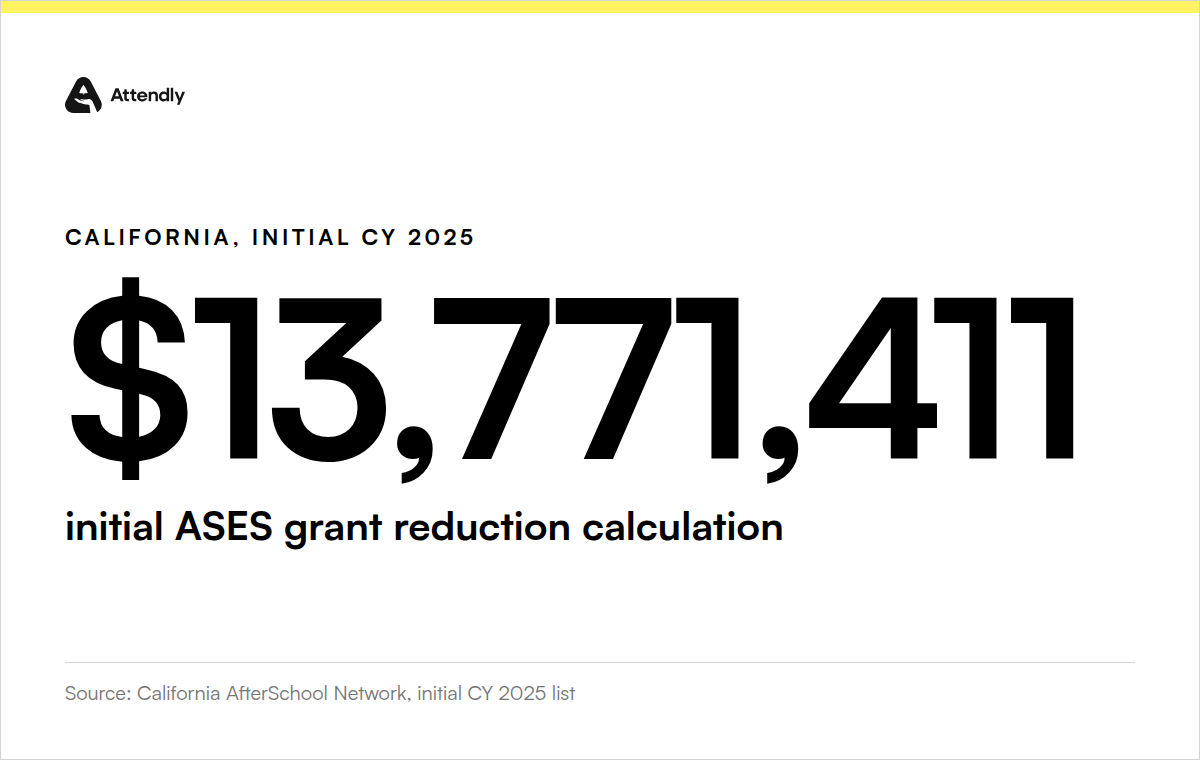
The California AfterSchool Network’s notice of the initial calendar year 2025 grant reduction list calculated $13,771,411.33 for ASES sites alone. Combined with 21st CCLC elementary and middle and ASSETs, the initial calculation totaled $29,486,232.09. That notice allowed attendance revisions before a final list. It does not say spreadsheets caused those numbers. It does say reported attendance missed the targets in Education Code 8483.7. A workbook is not what CDE measures. Student-days are.
This is not an argument about headcount. It is the cost of keeping the afternoon on a file that cannot survive a sample. CDE Fingertip Facts still count 1,011 districts and 5,731,260 enrolled students. Most of those districts already have a SIS. Statewide grant-reduction risk is the statute. Local cost is the rework, the audit packet, and the CALPADS file the workbook never becomes.
Four bills a spreadsheet quietly writes
What the workbook actually costs
-
Rework
Site tabs get emailed. District staff rebuild them. January numbers change in March. The hours are not a published FTE. They are the same week spent twice.
-
Audit exposure
The 2026-27 audit guide, Section U traces ASES pupils served to written attendance records. A formula the clerk no longer trusts is not that record.
-
Missed reporting
CALPADS Flash 305 wants expanded learning days on the LEAP file, program code 194, including zero-day enrollment. A tab named "afterschool" does not certify that file.
-
Grant dollars that move without a board vote
Education Code 8483.7 lets CDE cut an ASES grant to actual attendance plus a cushion when a site misses the targets. That is a statutory invoice, not a software opinion.
I am not pricing staff time. No public source gave me a statewide clerk-hour count I will stand behind. The grant figure above is an initial calculation. The hours are the work you already see.
Rework is the first cost, even when the grant survives
Paper at the door. A site spreadsheet at 6:30. A master workbook on Friday. A paste into ASSIST or the next reporting system before the window closes. Then a revision because two sites used different student ID formats.
CDE’s Federal Program Monitoring materials still expect sign-in and sign-out that show daily attendance by roster. That is the originating record. A Friday workbook can still trace to those sheets if the paper was filled the same day. The cost is rebuilding the week from the sheets, not the existence of a summary.
CDE’s electronic attendance accounting letter is a narrower document. It sets conditions for attendance systems that use digital teacher signatures for ADA. It is not a same-day electronic-entry rule for every afterschool spreadsheet.
Every recode is a second attendance day you already paid staff to capture.
Auditors do not sample your pivot table
If you take ASES money, Section U is the pupils-served script. The auditor traces reported days to originating records. If the originating record is a shared drive folder named “final_v7_USE_THIS,” you are betting the sample lands on a clean week.
ELO-P is a different script. Section DZ tests offer, access, hours, and ratios under Education Code 46120. It is not a pupils-served count. Regular attendance records are only an alternate way to show access. That distinction is in our ELO-P audit checklist. A spreadsheet that blurs ELO-P minutes with Recovery minutes still fails the Recovery sample in Section HZ.
School-day ADA has its own trace, in Section A, from P-2 back to the register. Expanded learning does not get to hide inside that register. We already said the SIS is the bell, not the afternoon, in Our SIS Already Tracks This.
Missed reporting is a quieter invoice
Flash 305 split the files on purpose. Recovery days go on STAS. Expanded learning enrollment and participation go on LEAP. Five minutes can be a participation day. Two programs on the same date are still one expanded learning day. None of that math lives comfortably in a column someone named “hours” in September and “days” in February.
When the certification window is open, staff stop running program and start reconstructing year-to-date. That is the hour cost I will not invent a number for. You already know what that week feels like.
The older operational version of this grind is still live: The Hidden Costs of Manual Attendance Tracking and 7 Signs Your Expanded Learning Program Has Outgrown Its Systems. The ASES reporting rules sit in ASES Attendance Reporting Requirements Explained.
The free tool is the one that cannot prove the day
Spreadsheets are a fine scratch pad. They are a bad system of record for a grant Education Code 8483.7 lets CDE cut, an audit section that traces to paper, and a CALPADS file that wants student-level days.
Attendly is not your SIS. We read from Aeries, PowerSchool, or Q SIS. The afternoon still has to be taken in the afternoon. If you want to see that workflow instead of another workbook, see the platform.
Sources
Where Attendly fits
See the rest of the day, not just the bell schedule
Registration, attendance, meals, and reporting in one workflow for California partners.
See the platform