
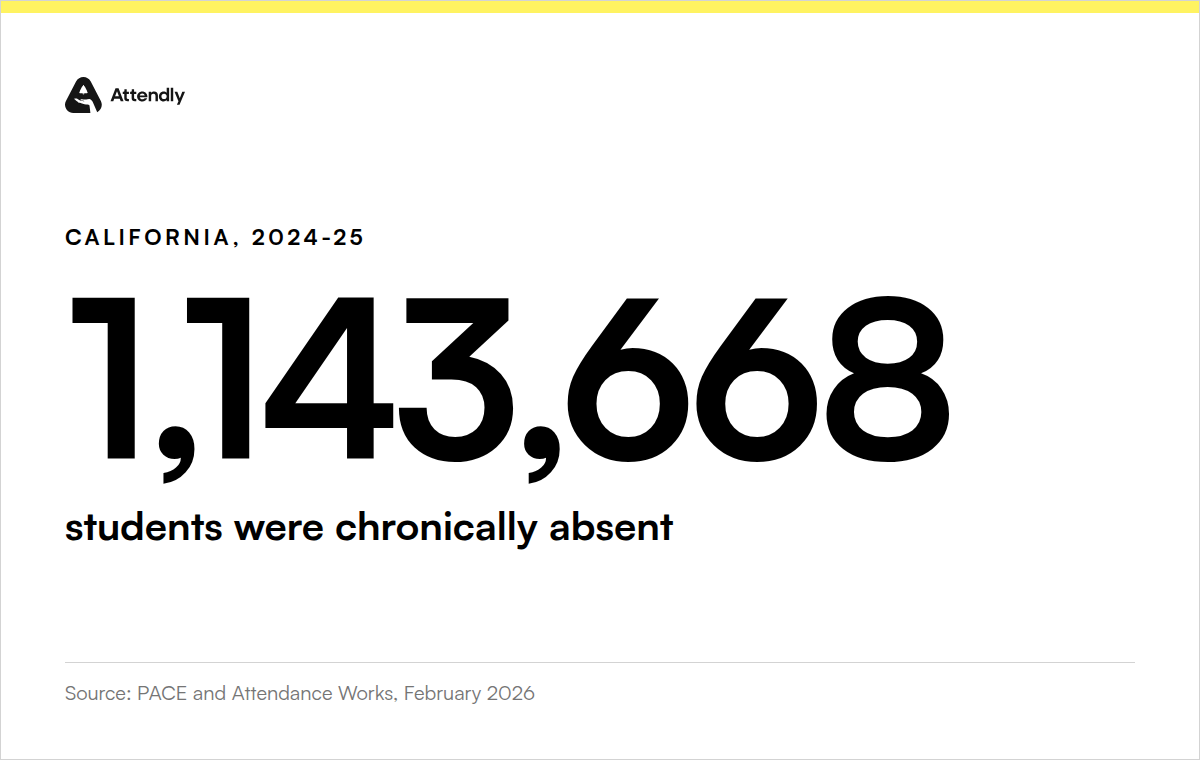
PACE and Attendance Works counted 1,143,668 chronically absent California students in 2024-25. CDE’s DataQuest file is the same count.
A lot of those kids already have a letter in the file. Fewer have had a meeting that changed anything.
That meeting is the Student Attendance Review Team. People say SART. Education Code 48262 never uses that name. It wants a conference. County offices and the state SARB handbook filled in the rest. If you treat SART as a hallway to SARB, you will fill the mill. If you treat it as the last cheap chance to fix the week, you might keep a kid in the building.
This is the how-to. The first parent notice is Education Code 48260.5. Education Code 48260 and 48261 are the truancy reports. Education Code 48262 is the conference, not another letter. AB 461 repealed the Penal Code 270.1 offense. It did not repeal the infraction and fine path in Education Code 48293. If the empty seats also need recovered days, the program rules live in Attendance Recovery in California: The Complete Guide. How to pull your own chronic absence count is in 1,143,668 Kids.
What the law actually requires
Education Code 48260 classifies a pupil as a truant after three unexcused full days in one school year, or three unexcused tardies or absences of more than 30 minutes, or any mix of those. The site reports that pupil to the attendance supervisor or the superintendent.
On that first classification, Education Code 48260.5 requires a notice to the parent or guardian. The current list, operative July 1, 2025, is not a threat letter. It has to say the pupil is truant. It has to say the parent is obligated to compel attendance. It has to name alternative programs. It has to say the parent has a right to meet with school staff. It has to mention mental health and supportive services. It has to say staff are available to meet to build strategies. And it has to include the research line the Legislature wrote: missing 10 percent of school for any reason can show up later in reading, middle school, and graduation.
Education Code 48261 is the second report. Once a pupil has been reported as a truant, one more unexcused absence or tardy is another truancy report.
Education Code 48262 is the conference. A pupil is a habitual truant after being reported as a truant three or more times in a school year. That label does not attach unless an appropriate district officer or employee has made a conscientious effort to hold at least one conference with a parent or guardian and the pupil, after the first or second report. Conscientious effort, in the same section, means at least one attempt to communicate, using a cost-effective method. Email and a phone call count. A signature on a SART contract is not required by that sentence. A real try at a conference is.
Education Code 48263 is the next door. A habitual truant, a chronic absentee as defined in Education Code 60901, or a pupil who is habitually insubordinate or disorderly, may be referred to a school attendance review board, or to probation if that office takes referrals. The referring person shall send documentation of the interventions already tried to the pupil, the pupil’s parents or guardians, and the board or probation department. The written notice names the board or probation office and the reason. It also has to say that the pupil and the parents or guardians will be required, along with the referring person, to meet with that board or probation officer.
SARB itself sits in Education Code 48320 and the sections that follow. Intensive guidance. Community services. Alternatives to court. That is a different room, with different people, after the site has a file.
SART is the site room that makes 48262 real, and that gives 48263 something to attach to.
What SART is, in practice
The state SARB handbook, which county offices still circulate as CDE’s 2018 text, is blunt. Unlike a SARB conference, the Education Code gives scarce guidance on how to run a SART. School sites should schedule one, or its equivalent, at the earliest opportunity. The handbook’s preference is right after the first truancy or excessive-absence notice, not after the third.
San Mateo County’s 2024 SART toolkit says the same thing in county language. A SART is a problem-solving meeting with the team, the parent or guardian, and the student. Hold it with the first notice if you can. Hold it with the second if you could not. Do not use it as a punitive forum.
CDE’s School Attendance Review Boards page is the state landing page for that process. Use it for the current handbook and model materials. If a county PDF and the Education Code disagree, cite the code.
Statute requires the truancy reports, the 48260.5 notice, a conscientious conference before the habitual-truant label, and documentation of interventions before a SARB referral. CDE and county offices direct sites toward an early, restorative SART. Practice recommends a written agreement and a dated follow-up. Do not sell the last two as if they were in Education Code 48262.
Who should be in the room
The state SARB handbook warns against the mill: one attendance clerk, a stack of folders, a family that already knows the speech. It wants a small panel. An administrator who can commit resources. The clerk who actually knows the register. A counselor or nurse when health or mental health is on the table. A teacher when the absences are period-specific. The handbook even flags a substitute so a teacher can sit the meeting.
San Mateo County adds data, wellness staff, child welfare and attendance, and after-school partners when the afternoon is part of the story.
Group SART, where you lecture a cafeteria of families, does not meet the handbook’s test. The family has a specific barrier. The meeting has to hear it.
The pupil belongs in the room unless the facts make that harmful. Education Code 48262 names the pupil in the conference. San Mateo County allows a parent-only meeting when the reasons are sensitive. Document why.
What to print before anyone sits down
I have watched a SART open with a dashboard screenshot and a lecture. The parent already knew the kid was out. Nobody in the room could say which days were unexcused, which were independent study, and which already had a recovered hour attached.
Bring a packet a stranger could audit.
- The Education Code 48260 classification date, and the dates that got there.
- Copies of the 48260.5 notice and any second report under 48261.
- A day-by-day list for this school year: present, excused, unexcused, independent study, suspension. Name the absence type. Do not hand a rate.
- Prior contacts: calls, emails, home visits, SST notes. Dates. Who tried.
- What the site already offered: counseling, transportation, a schedule change, Saturday school under Education Code 37223, short-term independent study under Education Code 51747.
- If Attendance Recovery is on the table, the Education Code 46211 tests: voluntary, certificated LEA employee, ratio, minutes, cap. CDE will not let you make Recovery compulsory. Do not put it in a SART contract as a penalty.
- Community resources you can actually book this month, not a county PDF from 2019.
The Saturday school comparison, if that is the lever you still have for a truant, is in Saturday School vs. Attendance Recovery. Short-term independent study, if a family trip or a medical stretch is the real story, is in Short-Term Independent Study in California.
The meeting itself
A SART agenda that can change the week
-
Open as a team, not a tribunal
Names, roles, and why this meeting exists: to get the pupil to school, not to win an argument. The state SARB handbook treats tone as the first intervention.
-
Put the days on the table
Read the actual dates. Let the family correct errors. A wrong unexcused day poisons the rest of the hour.
-
Ask what is in the way
Transportation, housing, health, work, safety, a class the pupil will not enter. Write the family's words. Do not skip this for the contract.
-
Name what the school will do
A ride. A counselor. A schedule change. A nurse follow-up. If you cannot staff it, do not put it on the page.
-
Name what the family will try
Wake-up plan, check-in adult, a same-day call when the pupil is out. Keep it specific to this week.
-
Write the agreement and the follow-up date
San Mateo County recommends calendaring a follow-up in the first meeting, often 6 to 8 weeks later. Put a nearer check-in on the clerk's calendar too.
This agenda is practice. The statutory floor is still a conscientious conference under Education Code 48262.
Do not read the old criminal line. AB 461 repealed Penal Code 270.1. If your script still threatens jail under that old Penal Code, rewrite the script before the next family sits down. Education Code 48293 is still an infraction with fines.
If the family does not come, the state SARB handbook says a home visit can be the SART. Document the attempt either way. Education Code 48262 is about conscientious effort, not a perfect show-up rate.
A worked hour, without a student name
A grade 4 pupil has three unexcused full days in September and two more in October. The site sent the 48260.5 notice after the third day. The clerk called once. Nobody sat with the family.
In November the principal finally holds SART. The nurse is in the room because the notes mention asthma. The teacher is in the room because two of the days were after a particular specialist class. The parent says the morning inhaler ran out, and the afternoon pickup for a younger sibling pulls the older one out at 1:30.
A weak SART would have the parent sign a generic “I will send my child to school” form and book SARB.
A meeting that can change attendance does four concrete things.
The nurse books a same-week health plan and a check on medications. The principal moves the specialist class, or gives a late-arrival window that is coded correctly, not hidden as present. The clerk sets a same-day call if the pupil is not in first period. The family names one adult who will text the clerk by 8:15 when the pupil is out. Follow-up is 15 school days, not 8 weeks, because the pattern is still forming.
If those days also sit in the chronic absence count, Attendance Recovery can be offered as extra instruction. It cannot be the punishment for missing school. That is Education Code 46211(c). Saturday school can still be required of a truant on one weekend day under Education Code 37223(c). Those are different statutes. Do not mix them on one line of the contract.
SART is not SARB
Site meeting and board meeting
| Test | SART (site practice) | SARB (statute) |
|---|---|---|
| Named in the Education Code? | No. The closest statute is the conference in EC 48262. | Yes. EC 48320 through 48325, plus referral rules in EC 48263. |
| When it usually happens | After the first or second truancy or excessive-absence notice, per the state SARB handbook. | After site interventions are documented, for a habitual truant, a chronic absentee, or habitually insubordinate or disorderly conduct. EC 48263. |
| Who is in the room | Site staff who can commit help. Parent or guardian. Usually the pupil. | A board the district or county constitutes. Community agencies. The referring person. The family. |
| What you must send | The parent notice in EC 48260.5. The truancy reports in EC 48260 and 48261. A local SART letter is practice. EC 48262 is the conference, not a third notice. | To the pupil, the parents or guardians, and the board or probation office: documentation of interventions already tried, the name and address of that office, the reason, and that the pupil and parents or guardians must meet there with the referring person. EC 48263. |
| What success looks like | The next 15 school days look different, and the file shows why. | Community services the board can actually direct, or a later step the board is authorized to take. |
If your county already published a SARB packet, use it. This page is the site meeting. Do not skip SART because the board calendar has an open chair.
The file after the meeting
A SART that changes attendance has a next Tuesday.
The clerk watches first period. The nurse checks that the appointment happened. Someone logs whether the school did the things it signed. If the pupil is out, the same-day call happens. If the pattern holds for the follow-up window, you have a packet Education Code 48263 will accept. If the pattern breaks, you still keep the notes. The next clerk should not have to reconstruct the hour from a calendar invite titled “SART.”
I keep saying the paperwork is the leak. That note is in Absences Aren’t the Biggest Leak. Paperwork Is.. SART is the same leak in a conference room. Hours can happen. The file still has to prove the intervention.
What to do this week
Pick 10 pupils who already have a first truancy notice and no conference on file. That is the Education Code 48262 queue. Do not start with the kids who are already on a SARB calendar.
For each one, print the day list, the notices, and one resource you can book this month. Schedule the meeting. Put the follow-up on the same calendar hold.
If Attendance Recovery is how you will offer extra instruction after the meeting, look at how Recovery runs in Attendly. Do not put Recovery on the contract as a sentence for missing school.
FAQ
Is a SART meeting required by law? The name is not in the Education Code. Education Code 48262 requires a conscientious effort to hold a conference with the parent or guardian and the pupil before the habitual-truant label. County offices and the state SARB handbook recommend doing that work as a SART, early.
When should we schedule it? The handbook prefers immediately after the first truancy or excessive-absence notice. San Mateo County says first or second notice. Waiting for habitual truancy is how you feed SARB.
Can we require Attendance Recovery at SART? No. Education Code 46211(c) and CDE treat Recovery as voluntary, never compulsory or punitive. You may offer it. You may not make it the consequence.
Can we still require Saturday school for a truant? Education Code 37223(c) still lets a board require truants, as defined in Education Code 48260, to attend makeup on one day of a weekend. That is not Recovery. Details are in Saturday School vs. Attendance Recovery.
What if the family never comes? Document every attempt. A phone call or email can be the conscientious effort Education Code 48262 describes. The handbook allows a home visit to serve as the meeting. You still need notes a SARB can read.
Does AB 461 change SART? It repeals the Penal Code 270.1 offense. It does not repeal truancy notices, SART practice, SARB, or the infraction path in Education Code 48293. Education Code 48263 still says a habitual truant may be referred to SARB. It does not make that referral mandatory. See the AB 461 bill text.
Where is the district-level SARB walkthrough? It is not on this site yet. Use CDE’s SARB page and your county packet until that guide ships.
Sources
- PACE and Attendance Works, February 2026 (PDF)
- CDE DataQuest, 2024-25 Chronic Absenteeism Rate, state
- Education Code 48260
- Education Code 48260.5
- Education Code 48261
- Education Code 48262
- Education Code 48263
- Education Code 48293
- Education Code 48320
- Education Code 37223
- Education Code 46211
- Education Code 51747
- Education Code 60901
- CDE School Attendance Review Boards
- CDE Attendance Recovery
- State SARB Handbook (2018 text, county-hosted PDF)
- San Mateo County Office of Education, SART
- San Mateo County SART Toolkit 2024 (PDF)
- AB 461 (2025)
Where Attendly fits
See how Attendance Recovery runs in Attendly
Scheduling, certificated ratios, and the documentation trail a board or auditor can follow.
Attendance Recovery