
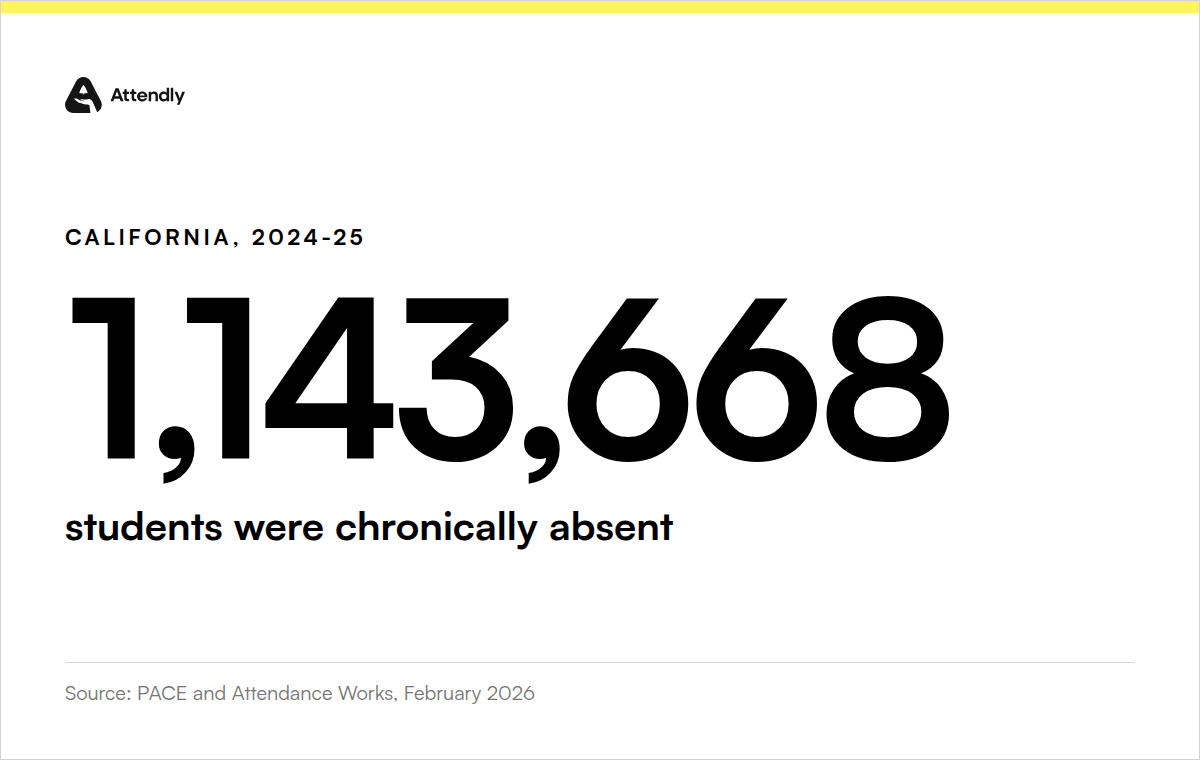
PACE and Attendance Works counted 1,143,668 California students as chronically absent in 2024-25. That count is kids, not a Dashboard color.
SARB is not that count. SARB is the file you build when a compulsory-age pupil keeps missing school without a valid excuse, or when chronic absence has already outrun the site. The statute is a sequence. Time gets lost between the steps: a first letter that does not match the code, a conference nobody can prove, a referral that skips the interventions Education Code 48263 requires you to attach.
Related posts stay live and do different jobs:
- 1,143,668 Kids: What California’s Chronic Absence Count Means
- Attendance Recovery in California: The Complete Guide
- Saturday School vs. Attendance Recovery
- What AB 461 Means for California Districts
SART and SARB do not replace those tools. They also do not make Attendance Recovery compulsory. Education Code 46211(c) still says Recovery shall not be compulsory or punitive.
What SARB is, and what it is not
Education Code 48320 says a School Attendance Review Board exists to provide intensive guidance and coordinated community services. If public and private services are not enough, the board may propose alternatives to juvenile court and use community resources first.
A county SARB may be established. If it is, Education Code 48321 lists who sits on it, from a parent through child welfare, health, mental health, the district attorney, and the public defender. Local boards may use the same mix. For a hearing, the chair may sit the members the pupil actually needs.
CDE’s SARB page is the state office for that structure. CDE’s truancy page is the summary of the letters that come first.
SART is not in those sections. There is no Education Code article titled Student Attendance Review Team. Sites use SART, or a parent conference by another name, to show they tried something before a SARB referral. That is how many districts meet the conference test in Education Code 48262 and the intervention documentation in Education Code 48263. It is practice, not a named board. Do not tell a cabinet that “SART is required by the Education Code.”
Two clocks: truancy and chronic absence
Compulsory full-time education covers each person between 6 and 18 who is not exempt. Education Code 48200. A TK or kindergarten pupil who is not yet 6 is not on that clock. Do not run a truancy ladder on a five-year-old and call it SARB.
Truancy is unexcused time. Education Code 48260 classifies a pupil as a truant after three full unexcused days in a school year, or three tardies or absences of more than 30 minutes without a valid excuse, or any mix of those. The district reports that pupil to the attendance supervisor or the superintendent. Districts are not required to switch to period-by-period accounting to do it.
A valid excuse includes the reasons in Education Code 48205 and 48225.5, and may include other reasons an administrator treats as valid on the facts. Illness, including mental or behavioral health, is on the 48205 list. If the clerk codes a doctor’s visit as unexcused because the note arrived late, you can manufacture a truant on paper.
Chronic absence is different. Education Code 60901 counts a pupil absent on 10 percent or more of the schooldays enrolled, excused or not, excluding Saturdays and Sundays. CDE DataQuest publishes that count. A pupil can be chronically absent with a stack of excused illnesses and never meet 48260.
Education Code 48263 lets you refer a habitual truant, a chronic absentee as 60901 defines that term, or a pupil who is habitually insubordinate or disorderly. Those are three bases. Do not collapse them into one letterhead.
Chronic truant is a third label. Education Code 48263.6 is unexcused absence for 10 percent or more of the schooldays from enrollment to the current date, after the district has already walked 48260 through 48263 and 48291. Keep that label off a Dashboard screenshot.
The process, as the code sequences it
From the third unexcused day to a SARB outcome
-
Classify and notify
Education Code 48260 classifies the pupil as a truant. Education Code 48260.5 requires the first parent or guardian notice, by the most cost-effective method, including email or a call.
-
Report again
After that first report, one more unexcused day or tardy is another truancy report under Education Code 48261.
-
Conference, then habitual
Three or more reports in a year can make a habitual truant, but only after a conscientious effort to hold at least one conference with the parent or guardian and the pupil. Education Code 48262 defines that effort as at least one attempt by the most cost-effective method. Many sites do that work in a SART meeting. CDE describes the habitual-truant conference as a mandate.
-
Refer, with the packet
Education Code 48263 says the pupil may be referred to SARB or to probation if probation takes these cases. The referring person shall give the pupil, the parents or guardians, and the board documentation of the interventions already tried, plus a written notice of the board's name and address and the reason for the referral. The notice shall say they will have to meet.
-
Hearing and next step
If community services can resolve it, SARB directs the family to those services and may require proof of participation. If they cannot, or the family does not respond, SARB may notify the district attorney or probation under Education Code 48263.5. Education Code 48264.5 is the separate ladder of possible pupil consequences from the first through fourth truancy report.
Statute requires the sequence. CDE summarizes it. SART is how many sites document step 3. It is not a sixth board in the code.
The first letter is a statutory list
On a pupil’s initial classification as a truant, Education Code 48260.5 requires the district to tell the parent or guardian all of the following, using the most cost-effective method:
- The pupil is truant.
- The parent or guardian is obligated to compel attendance.
- Alternative educational programs are available in the district.
- The parent or guardian has the right to meet with school personnel to discuss solutions.
- Mental health and supportive services may be available.
- School personnel are available to meet to develop strategies that support attendance.
- Research shows that missing 10 percent of school for any reason can translate into difficulty learning to read by third grade, achieving in middle school, and graduating.
That list became operative on July 1, 2025, after SB 691 (2024) rewrote the section, as Education Code 48260.5 records. CDE repeats the first-notification mandate. Cost-effective includes email or a telephone call. A certified letter is not required. What is required is that you can show the notice went, and that it contained the list.
This is the first stall. Someone waits three weeks for letterhead. Someone mails a 2019 template. Someone logs “called home” with no date and no script that covers items (a) through (g).
Second report, third report, then habitual
Education Code 48261 is one sentence. After the pupil has been reported as a truant, one more unexcused absence or tardy is another report.
Education Code 48264.5 then attaches possible next steps to the count of truancy reports in the same year: a root-cause meeting, a peace-officer warning, referral to an attendance review board or mediation, and, on a fourth report, possible juvenile court jurisdiction under Welfare and Institutions Code 601. The fourth-report options in that section include court-approved community service, a fine of not more than fifty dollars, or a truancy prevention program.
Weekend makeup for a truant still sits in Education Code 37223(c), which CDE keeps on the instructional-time page. That is Saturday school, not Attendance Recovery. Do not print “SARB Saturday” on a Recovery flyer.
Education Code 48262 will not let you brand a pupil habitual until an appropriate district officer or employee has made a conscientious effort to hold at least one conference with the parent or guardian and the pupil, after a 48260 or 48261 report. One documented attempt can satisfy the floor. A no-show does not erase the attempt if you can prove you tried.
A useful SART meeting is higher than that floor: a written plan, a next date, and someone who can actually offer support. CDE frames later SARB work as intensive guidance meant to divert pupils from juvenile court, citing Education Code 48320.
Three stalls show up here. The meeting is held in May, after habitual has already been stamped. The family brings notes that would have been valid excuses under Education Code 48205, and nobody recodes the days. Someone treats Attendance Recovery as the consequence. Recovery cannot be the stick. Education Code 46211(c). Offer it as extra instruction. Keep truancy on its own statute.
If you want the Recovery rulebook after the meeting, use the Attendance Recovery hub. If the leak is the folder, Absences Aren’t the Biggest Leak. Paperwork Is. is the shorter version.
The referral is a packet
Education Code 48263(a) is the sentence districts skip. The person making the referral shall provide documentation of the interventions undertaken at the school to the pupil, the parents or guardians, and the SARB or probation department. Then a written notice: name and address of the board, reason for the referral, and a statement that the pupil and parents or guardians will be required, along with the referring person, to meet.
“May be referred” is the verb. Classify habitual when 48262 is met. Refer when the site file supports it.
A printout of period attendance is not an intervention. A SART plan, a home visit log, a counseling referral, a transportation arrangement, an independent study conversation that actually produced an agreement under Education Code 51747. Those are interventions. Short-term independent study is a concurrent program with its own signatures. It is not a truancy letter.
Time gets lost when the site has a hearing date and no packet, or a packet and no proof the family was told the address, or a referring administrator who cannot attend.
In a county with no SARB, Education Code 48263(c) lets the district notify the district attorney or the probation officer, or both, only if the district determines that available community resources cannot resolve the problem, or that the pupil, parent, or guardian failed to respond to district directives or services, and only if those offices elected to participate in truancy mediation under Education Code 48260.6. Do not invent a county board because the handbook has a logo.
The hearing, then the fork
Education Code 48263(b) is the fork. If available community services can resolve the problem, the board directs the pupil or the parents or guardians, or both, to use them, and may require proof of participation. If those services cannot resolve it, or the family does not respond, the board may notify the district attorney or probation under Education Code 48263.5, if those offices elected to participate. Those offices may warn that the parents or guardians may be subject to prosecution under Education Code 48290 and following, and may ask the family to a meeting under Welfare and Institutions Code 601.3.
That is Education Code, not Penal Code 270.1. AB 461 repealed Penal Code 270.1 effective January 1, 2026. That walkthrough is the scrub list for letters that still threaten jail under that section. Pull those sentences. Do not tell a board that every parent consequence disappeared. Article 6 of the truancy chapter is still in the Education Code.
A worked path, with no names
A grade 7 pupil is 12. Compulsory attendance applies. Education Code 48200.
In September the pupil has three full unexcused days. The attendance supervisor gets the 48260 report. The first 48260.5 notice goes by email the same week, with all seven items. That is report one.
In October one more full unexcused day lands. Education Code 48261 is report two. The site holds the 48264.5 meeting and writes a joint plan.
In November another unexcused day lands. That is report three. The site already has a conference on file, so Education Code 48262 can treat the pupil as habitual. At the SART meeting the parent produces Education Code 48205 notes for two of the fall days. Those two days recode as excused. Three unexcused days remain. Three unexcused days still support the first 48260 classification. They do not support the second and third reports, and they do not support habitual. The 48263 packet stays put until later unexcused days rebuild that count. The plan offers a Recovery seat after school. Recovery is optional. Education Code 46211(c).
If later unexcused days rebuild three reports, and the conference is still on file, CWA builds the 48263 packet: the notices, the conference log, the SART plan, the recoded register, the Recovery offer the family declined. The written referral names the SARB and the address. The referring administrator shows up. The board either directs community services or, if that is exhausted, uses 48263.5.
None of that needs a student name in a public post. It needs dates in the file.
Where the file stalls
Excuse law lives in a drawer. Education Code 48205 is longer than most first letters. Mental health absences are excused. A funeral has a five-day cap per incident. Truancy that starts in the wrong code will not get healthier at SARB.
The first notice is the old letter. Education Code 48260.5 changed on July 1, 2025. Supportive language is not garnish. It is the section.
Habitual is declared without the conference. Three reports feel like enough. Education Code 48262 disagrees until the conscientious effort exists.
Chronic absence and truancy share a mail merge. Education Code 60901 counts excused days. 48260 does not. A family drowning in asthma absences needs a health plan, not a habitual-truant stamp. They may still be referable to SARB as a chronic absentee under 48263. Say that clearly.
The referral has a hearing date and no interventions. Education Code 48263 told you to attach them.
Recovery, Saturday school, and SARB share a flyer. Saturday school can still require a truant on one weekend day under Education Code 37223. Recovery cannot. CDE is blunt. SARB is guidance under 48320. Three statutes. Three files.
CDE Fingertip Facts still count 1,011 public school districts and 5,731,260 enrolled students. I am not attaching a statewide dollar to a SARB hearing. LCFF does not price one conference.
Your SIS is your system of record. Attendly is your system of action. The school-day codes still live in the SIS. The next step, the letter, the conference, the packet, has to actually happen.
FAQ
Is SART required by the Education Code? No named SART appears in Education Code 48260 through 48321. The conference effort in 48262 and the intervention file in 48263 are required when you use those sections.
Must every habitual truant go to SARB? No. Education Code 48263 says the pupil may be referred.
Can we refer a chronically absent pupil who is not a truant? Yes, if they meet Education Code 60901. Education Code 48263 lists that as a separate basis.
Can we require Attendance Recovery as a SARB directive? No. Participation shall not be compulsory or punitive. Education Code 46211(c).
Did AB 461 end SARB? No. AB 461 repealed Penal Code 270.1. The truancy article and Education Code 48320 remain.
Does a recovered day erase the truancy report? Recovery can offset an absence for ADA under Education Code 46211. CDE describes an alternate chronic absenteeism rate. It does not rewrite a 48260 classification.
Where should we start this week? Print 48260.5 next to your first letter. Print 48263(a) next to your referral form.
If the next step after a closed SARB file is extra instruction that can earn ADA, start with Attendance Recovery.
Sources
- Education Code 48200
- Education Code 48205
- Education Code 48260
- Education Code 48260.5
- Education Code 48260.6
- Education Code 48261
- Education Code 48262
- Education Code 48263
- Education Code 48263.5
- Education Code 48263.6
- Education Code 48264.5
- Education Code 48290
- Education Code 37223
- Education Code 46211
- Education Code 48320
- Education Code 48321
- Education Code 60901
- Education Code 51747
- Education Code 48260.5 (SB 691 rewrite, operative July 1, 2025)
- AB 461 walkthrough
- CDE truancy
- CDE SARB
- CDE Attendance Recovery
- CDE instructional time and attendance accounting
- CDE Fingertip Facts
- PACE and Attendance Works, February 2026
Where Attendly fits
See how Attendance Recovery runs in Attendly
Scheduling, certificated ratios, and the documentation trail a board or auditor can follow.
Attendance Recovery